Are the trolls stupid – and evil?

Kittelsen: Skogstroll

The trolls in folklore originate from the jotnar. The jotnar were in conflict with the Aesir. They were the arch-enemies, and it was the jotnar who caused all the disasters in connection with Ragnarok. Yet, the jotnar were feared, but also respected.
When Christianity made its entrance, they tried with all their might to 'eradicate both the Aesir, Vanir, and Jotnar.' But the Jotnar and dwarves, who in many ways can be said to represent the forces of nature, lived on in folklore, now as trolls and dwarves. The trolls had become evil and stupid, and the dwarves had become small and lived inside the mountains.
The giants were not stupid and evil in the first place. Odin, the chief god, was half of giant descent. His father, Bor, was the son of the primeval god Bure, who was licked out of the salt stones in Ginnungagap by the primeval cow Audhumla. The saga does not mention anything about Bor's mother, but he was at least married to the giantess Bestla, daughter of the giant Bolthorn. She was then the mother of the trio Odin, Vé, and Vili.
Loki, Odin's friend and blood brother, was of Jotun descent. That is to say, his father, Fárbauti, was undoubtedly of Jotun lineage, while there are those who claim that his mother, Laufey, was an Aesir. In any case, Loki is considered to be of Jotun descent, yet still respected as an Aesir, and he resides in Asgard. He is Odin's blood brother and Thor's best friend. His relationship with Freyja and Heimdall can probably be said to be a bit more variable.
Another jotunn who resided in Åsgård was Mímir. He was the wisest of all, Æsir, Vanir, and jotnar alike. He was the guardian of the well of wisdom, Mímisbrunnr. Whoever drank from the well gained wisdom. Odin was allowed to drink from the well in exchange for pledging an eye, which was placed in the well. Nevertheless, he had to consult Mímir, later Mímir's head, when important decisions were to be made. Mímir met a somewhat unfortunate fate. War was, as it is now, not an unfamiliar phenomenon. The Æsir and Vanir fought and waged war among themselves. But in the end, they realized that nothing good would come from this fighting. They made peace and sent hostages to each other.
Høne and Mime were sent to the Vanir, while Njord and Frey were sent to the Aesir. The Vanir were not entirely satisfied with the exchange. They felt that they had sent more significant hostages to the Aesir than what they had received in return. They cut off Mime's head and sent it back. Odin took care of it, prepared it, and could still speak with it and receive advice. Another Jotun, who perhaps does not exactly live in Asgard since his hall is under the sea, but who is highly respected and frequents good company, is the jötunn Ægir, ruler of the sea. He is married to Ran, a personification of the sea. It is not clear whether she is an Aesir or a jötunn, but as a personification of the sea, she is probably a jötunn as well.
Among other Jotuns, those who lived in Jotunheimen, can be mentioned Trym, the one who stole Thor's hammer and demanded Freya in exchange. Quite a crude guy, but still not particularly intelligent. His morals could probably be described as questionable. Utgårdsloke could probably be described as a trickster. A big trickster. When Thor and his companions were on their way to Trym, they found a cave where they spent the night. The cave had two rooms, one large and one small. When they got up the next morning, they saw that the cave was actually a mitten. Utgårdsloke’s mitten. He tricked Thor into breaking backs with Elle, the personification of old age, drinking from the sea in a drinking contest, and trying to lift the Midgard Serpent, believing it was a cat. The Jotun Tjaste tried to kidnap Idunn, but it went badly for him. He was burned by Odin and killed by Thor. Then we have the giant Rugne. Not particularly intelligent, but considered the strongest of all the Jotuns. His buddy, Mokkurkalv, large and incredibly strong, is by some considered a Jotun. He was as dumb as a loaf of bread and besides, cowardly and easily frightened, but was, after all, an artificial figure, built by the giants to participate in a duel against Thor and Thjalve. Unfortunately, they had made the mistake of giving him a mare's heart. When he saw Thor, he was utterly terrified. He was then killed by an arrow from Thjalve. By the way, it can be mentioned that Thjalve and his sister Roskva were neither Aesir, Vanir, nor giants. They were humans.
The giant Vavtrudne was considered very wise and knowledgeable. Odin was anxious that Vavtrudne might turn out to be wiser than himself. He therefore disguised himself, called himself the Wanderer, and went to Vavtrudne to try to trap him in a contest of knowledge. But Vavtrudne matched him freely and was equal in knowledge. Finally, the Wanderer asked, 'What words did Odin whisper in the ear of the dead Bragi as he lay on the funeral pyre?' Then Vavtrudne had to give up and answered, 'No one knows what your son said in your ear in ancient times.' With this, he admitted defeat, but also revealed that he had seen through Odin's disguise.
As one can see, the trolls were neither evil nor stupid. Some were, but the same was true for the Æsir (we probably can't exclude humans from that either). There was a mutual respect between the races. There was extensive interaction between the clans. That lasted all the way until Ragnarok, that is. And Ragnarok, we are still waiting for.
It is only when Christianity makes its entrance that the trolls become evil. Partly, the Æsir are also counted among the wicked and fought against with harsh clerical hands. The ancient Norwegians were not particularly literary. It was the oral storytelling tradition that prevailed. They had the runes, but these were not particularly suitable for writing history or long explanations. They were mostly used to carve witty sayings into stone or wood.
Most of the Norse mythology as we know it was written down from the 1100s onwards. With Christian pens. Snorri Sturluson, who is perhaps the greatest contributor to what we now know, was a Christian. This has naturally had an influence. Even though Snorri might be considered a dedicated historian, some Christian bias probably shines through in his writings.
Otherwise, the priests did what they could to eradicate both jotnar, Æsir, trolls, Vanir, both overworldly and underworldly beings. There was supposed to be only one god, Christ, who mattered. By the way, that was why the Christians were unpopular in ancient Rome. It wasn’t because of the one god. The Romans already believed in many gods, and one more – well, they could probably tolerate that. But when all the old gods were to be exterminated and the new god was to be in charge – not just in charge, but the one and only. Yes, that was unbearable. And furthermore, a god who demanded submission and asceticism and threatened eternal suffering, in contrast to the Romans’ more human-like gods with their flaws, their jealousy, their appetite for relationships with humans, and their sense of festivity and celebration.
The old royal candidates, the Olavs, Tryggvason and Haraldsson, probably considered Christianity as a suitable tool to subdue the old Norwegians. Both farmers and fishermen and Vikings. They had probably learned from the emperor in Byzantium. Constantine the Great who quietly introduced Christianity to the Roman Empire and used it to patch together a crumbling Roman Empire and to consolidate power with the emperor. It was Constantine who convened the Church Council in Nicaea (in the year 325) where they fairly agreeably decided what they were supposed to believe. At a later church council in Carthage in the year 397, it was agreed which books should be included in the Bible. Well, this is perhaps somewhat disputed whether it really was in Carthage, some believe it was earlier, but for now, we’ll stick with Carthage.
Christianity in the Nordic countries was introduced with a heavy hand and with a sword in hand. Or an axe. Many were given the choice of either being baptized or losing their farm, land, and life. And their descendants. Only the most powerful could resist for a while longer. And those who lived far away, like Erik the Red in Greenland. His son, Leif the Lucky, the Vinland Explorer, paid a visit to Norway and there he had to be baptized.
Since then, it followed blow after blow, with tithes, witch burnings, and all the way up to our times with various ignoble actions with Christian intent and corresponding approval, against the population in the northernmost parts of the country, the Sami.
The old Norwegians were tough and brutal. So were their gods. But, like the gods of both the Romans and Greeks, they were more human, had flaws, were jealous and vengeful. They were perhaps not as eager to mate with humans as the more hot-blooded Mediterranean gods. It is possible that the jötunn women were more interesting in that regard.
One cannot help but wonder, would we not have been just as well taken care of by trolls and giants, gods and dwarves as by Christianity. Not to be understood as wishing for the old times, nor for Norse paganism, to return. Surely no one with most of their wits about them does. The world has moved on. We have different norms for human relationships, we can explain lightning and thunder without having to resort to thunder gods.
But the strange thing is: many, among them presumably intelligent people, firmly believe that Jesus will come back, that he will judge both the living and the dead. Not based on their deeds, but on whether they have prayed enough for forgiveness, whether they have shown enough gratitude. Almost something Trumpish about it all (couldn't help myself). In addition, they believe that we, in order to appease their deity, should implement the same laws and rules of conduct that applied in the regions of the eastern Mediterranean over 2000 years ago.

Svearing

What exactly is swearing? Nowadays, swearing is a hot topic in the comment sections. Apparently, some TV programs started it all. I haven't watched any of these programs, so some might argue that I am not entitled to an opinion on this matter. But as I understand it, it is the Northern Norwegian tendency to spice up their explanations with crude words that do not quite appeal to the more proper part of the population, which primarily resides in the southeastern parts of the country. Some might use the word narrow-minded, but I refrain from doing so. It is after all not their fault that they live in a part of the country where, at best, they can pee in brackish water. As one moves further north and west, the sea becomes saltier, and so does the language.

But what exactly is swearing? Strong language, without a doubt. There are so many different kinds of strong expressions. Sometimes they may just be ordinary, everyday words, but pronounced with such intensity and sincerity that they are perceived as swearing just because of that. Then we have the religious curse words. These usually include both what is in the Bible and what is not. Both the devil and hell are popular themes around which strong expressions are centered. Sexual themes are also popular. In fact, I feel I sense that these are on the rise at the expense of the religious curse words. Personally, I think this is positive, because swear words are generally formed from things we think about. And thinking more about life than death, well, that is good. Because sexuality definitely belongs to life, even though it is precisely sexuality that makes death necessary. But that is a completely different discussion. Devils and their dwellings, on the other hand, belong to death. But even here there is a contradiction. When hell is mentioned, we often imagine a dark, underground place with glowing coals and other torments. But another name for the devil is Lucifer – the bearer of light. And hell, that means the place of light. One might then wonder about these 'mediums' who appear on TV and are supposed to help troubled souls to the other side. They encourage people to 'go towards the light.' But where are they really sending the poor souls?

But now I'm getting sidetracked. Back to swearing. In addition to the fact that swear words are of different kinds, they are used in different ways. They can be used in everyday conversation, often with a humorous touch. They are also a tool you can use when you want to be a bit ironic. Irony is, after all, a highly valued art in Northern Norway. Unfortunately, this irony is not always understood in the southeastern regions. Then there are the genuine, spontaneous outbursts with emotion and real immersion that happen when things suddenly and unexpectedly go wrong. For example, when the nail cowardly bends away so that the hammer hits the thumb with great force and determination. Then some juicy, heartfelt curses, spoken with emphasis and flair, are appropriate. These can, for instance, prevent frustration-driven throwing of hammers, which can easily lead to further injuries. Spontaneous outbursts can also occur as a 'the cup is full' effect after prolonged unresolved frustration. Swearing can also be used to irritate or provoke those around you.Just as teenagers try out swear words at home to explore their boundaries. Swear words used purely for provocation are especially common in comment sections.

Although I am of the opinion that one should limit the use of strong language, especially in polite company, I am of the view that it is a valuable part of the language. Some claim that those who swear have a limited vocabulary. For some, this may certainly be true, although I am far from sure whether there is any correlation between these two things. For others, it is not true at all. There are masters of the art of swearing who can go on for half an hour without a single repetition. Unfortunately, swearing in English-language films is a shaky matter. Mostly, there are two words that recur: 'bloody' and 'fuck.' Nor does hip-hop culture impress. Of course, it is both provocative and offensive to be accused of—or encouraged to—have intercourse with one's own mother, but honestly, when the same word appears every other second, it is reasonable to suspect the 'poets' of having a very limited vocabulary.

Just as there are differences in how swearing is delivered, there are also differences in how it is perceived. For those who do not understand or cannot share the emotional expression that genuine thumb-slap exclamations convey, or do not understand the humor in a story sprinkled with juicy exaggerations and reinforcing auxiliary words, it will likely seem flat and unnecessary. Therefore, great demands are placed on the storyteller to adapt their choice of words to both the audience and the occasion. As Krestjan the first mate said to the pastor when he was reprimanded for 'banding and rotten speech': «De kan nok gå an for Jær, Prost, for om I står på stolen å om kjeften forskjær sæ for Jær, så kan I slå en kremt i han, å så kan I ta Jær att igjen. Det bi’kje sålessen før mæ, nei. Når æ skal løp galleasen i hamn me høgrokke plystre i vevlingan, då bi de kje før mæ å slå nokka kremt i’an.»  (sitat fra Vett og Uvett av Einar K. Aas og Peter Wessel Zapffe)

When it comes to swearing on TV, it is indeed difficult to control who sees and hears it. In such cases, it's more about adjusting the language to the situation. Take, for example, Oluf Rallkattli (Arthur Arntzen, a master of humor). He uses a lot of forceful expressions, but little or no swear words. There are also requirements for the audience. The easily offended should probably seek another type of entertainment. Surely there are those who find it directly unpleasant to listen to. I feel the same way about some TV programs. There is a simple cure for this: just don’t watch or listen. But it is also permissible to have an opinion on the matter and express it, for example in a comment section. Then I think that such opinions should also be met with respect. There is no need for name-calling and characterizing opponents. You can disagree without degrading the other party. Bold expressions are allowed to everyone, as stated in the Constitution §100 (it's not exactly what it says, but it's close enough). It should also have stated that humorous expressions are all permitted (including some strong language).

Long live stubbornness.

If anyone is wondering how it happens that the seagull can fly, I can tell you right now. It's pure and unadulterated STUBBORNNESS! That flapping of the wings is just for show. No, he flies on pure stubbornness. He's even more stubborn than the wi… well, let's leave that unmentioned. But in any case, he's the most stubborn thing you can wrap in feathers.
I have now politely tried to talk properly with him and persuade him to move his nest and breeding site to places other than my porch. There should be plenty of suitable places in the local area for nest building.
For a while, I thought he was aiming for a mobile existence, because every morning I found straw and twigs and things like that on the car roof. But here yesterday evening, quite late yesterday evening, actually long after a reasonable bedtime, I was letting the cat out. Then I realized what was going on. They are doing their thing on the car roof. So the arrangement with straw and twigs is probably just to prevent the flat-footed ones from slipping on the slippery roof. It’s probably nice to get a little push-off when the seagulls are at their worst.

I had now convinced myself that it was too late for this pair of seagulls. They haven’t had it easy this year, being homeless and chased around as they have been. Twice, their egg has been taken from them. I thought the season was lost for them. But not at all. When I saw the activities they were up to on the car roof, I realized there was more to come. And sure enough, this afternoon when we came home from work, they had made a nice little nest bowl. Where to? Well, I can tell you. In the other flower box on the steps. Well, not ON the steps, as it hangs outside the railing, but still. No egg has been laid yet, but the intention is clear.

That stubborn bird!

Larissa

Larissa, and not to forget her mate, Larris. Last year they settled on the garage roof, right at the edge, where they took turns incubating a single egg. Eventually, out came a little gray-green speckled downy chick, and the seagull-like happiness was immense. Yes, we shared, more or less, the excitement over the little one. But both Larris and Larissa became quite grumpy and quarrelsome. Not to mention loud-mouthed. There was screeching and scolding like no other whenever someone went out the door. Well, we thought, it won’t last that long. But it did. The fairly flat garage roof with asbestos-cement sheets was a perfect nursery for the seagull chick. There was busy traffic to and from with treats for the growing family. Every time the feeding express had a free moment, there was either loud choral singing from the roof ridge or dive-bombing after the cat or other creatures unfortunate enough to be in what they clearly defined as a forbidden area. However, it must be admitted that the residents of the house had a kind of free pass to move around the area as long as they stuck to ordinary, everyday tasks. Except for the house cat. The cat developed acute agoraphobia. It eased a little over the winter, only to be replaced by a touch of cryophobia, but now the agoapphobia has flared up again.
The maternity ward on the garage roof eventually turned into a kindergarten, preschool, elementary school, and finally a middle school. Every day when we came home from work, the little one was the first thing we looked for, to see if it had jumped down. But we were disappointed—every day. We even set up an old foam mattress to soften the fall, but it didn't help.

But suddenly one day, he was both able to fly and confirmed and almost an adult, and then he was gone. Peace settled over the courtyard, and we could once again welcome visitors without equipping them with helmets and hearing protection. It was in that context that I had a serious talk with Larris and clearly warned him that we would not tolerate this. They were evicted from the garage roof and were welcome to find another breeding place.
Then winter passed and spring came. And with spring, two clearly spring-crazed little seagulls: Larissa and Larris. They were busy with what seagulls do on bright spring nights. Such springtime gull activities eventually lead to an intense urge to build a nest, and the serious talk we had had was obviously forgotten. I felt compelled to put power behind my words and demanded the removal of the illegal structures. After two or three attempts, I realized that stronger measures were needed. A seagull-scaring owl was purchased. 'Greets passersby with blinking eyes and a friendly hoot,' it said on the box. Friendly hoot? By now, we were well past the friendly phase. The owl looked so plastic and unconvincing that I was embarrassed to show it to the seagull. It was never set up, just packed away and forgotten. A ladder with a fluttering red plastic bag seemed to do the job. Now it only covers a small part of the garage roof, but fortunately, it seems that it's exactly that spot which is the only suitable seagull nesting site. For it eventually got through the plumage that the garage roof was terra clausa for nesting. In sheer desperation, Larris set up an emergency nest in a flower box outside the steps. It was high time, because as soon as the last straw was laid, an egg plopped out. Now it may be that they got very busy 'charging' the next egg, and less concerned with taking care of the one they had, for the next morning the egg was gone without a trace. 'What do we do now, little dove?' said Larris. 'Pressure's building up, it's building up, hurry, hurry,' said Larissa. She couldn’t scream out the proper seagull way, because she was afraid the egg would just pop out. Larris understood that there was urgency, so he arranged some straw in the nearest flowerpot so she could relieve herself. And there they lie now, Larissa and their egg. Yes, Larris is diligent and takes his turn incubating too. He has a slightly milder temperament than Larissa. She is more short-tempered, especially if someone surprises her. Otherwise, they have become quite friendly while incubating. Even the cat is quietly tolerated. Well, quietly might be an exaggeration. Using an indoor voice is not something seagulls are good at. But one thing is certain: when the egg hatches, the area will be evacuated fairly quickly. No seagull chicks get to sit in peace until they are capable of flying, and even more so. (I hope)


Update: Today, when we got home from work, a small tragedy had occurred. The seagull was lying on its nest but took off immediately when I swung into the driveway. Otherwise, they have not been so easily disturbed. They have stayed put and incubated diligently even when we stood on the porch just a meter away. Something had happened here, I thought. Then I went up to the porch and saw this:

Life is sometimes quite short – especially a seagull's life that has not yet come out of the shell. We suspect that it might be the magpie that is to blame. It has a nest up in the tree right next to the stairs and has a full view of everything the seagull might be doing. Perhaps it has been lying in wait and struck in an unguarded moment. The misdeed must have happened quite recently, I suppose. Then we'll see what happens next. If the seagull gives up, it lays a new egg in the nest or finds a new nesting place.

Vita brevis, acuta rostro!

New webcam

Finally, a new webcam is up and running. This is a so-called 'bullet' camera. It has an outer casing that can withstand weather and wind. The previous one didn't have that; it was a camera intended for indoor use. It was also mounted inside the garage, but I had made a hole in the garage wall so it could look through. This, of course, also limited the field of view somewhat.
This camera is mounted outside, up on the wall, and has a much better view. That is to say, I need to adjust it upwards so that it shows a little more of the sky. I will do that next time I pass by. The camera faces Furøy and Gottesjord. It will be nice in the spring when the sun comes back and shines on the hills of Gottesjord.
Now it is dark for much of the day, and then there is not much to see, except for the lights on the other side. The camera has IR illumination to light up the foreground. The only problem is that there is no foreground. I have still left the IR illumination on because it makes it easy to see if there is precipitation even in the dark. If there are white streaks across the image, then it is raining or snowing. If the streaks are horizontal, then there is also wind.
The camera takes pictures every 10 minutes. It can take up to 5 minutes from when the picture is taken until it is uploaded. The pictures are sent to Weather Underground, where you can see previous images, and you can view a time-lapse video for each day.
Here is the webcam directly
Here is videos and more
The images from my webcam are free for anyone to use for any legitimate purposes. If they are used, I would appreciate it if a small source reference is included.
Have fun!

-But how long was Adam in paradise? The camera stopped working after a few days. Maybe it can't handle frost. Very annoying, but I guess that's what happens when you buy cheap from Wish. To be continued . . .

Kråkeslottsfestivalen (Ramshacle castle festival) 2016

One thing I am sure of – I am not going to be troubled by kidney stones in the near future. It should also be noted that it is an affliction I have never suffered from. But in any case, I have just been fully vaccinated against such conditions. You see, I try to make it to the Kråkeslott Festival every year. So I did this year as well. I find it a bit too much to attend for three full days straight, so this year I chose Saturday. I am also the kind of person who is somewhat slow when it comes to preparations and planning, so it ended up being a bit of a last-minute ticket purchase. As a result, there is also a light aura of chance over the selected events. That is, Toini and the Tomcats was no coincidence. They were rather the reason I set off on the trip. But I had two more tickets – once you're going on a trip, you have to get the full value. And I knew very little about those performers. So, after running various errands in Finnsnes, I headed out toward Senja and just about made it to the first concert. I sneaked in half-dark wearing glasses that were still dark from the daylight outside. It was just a matter of feeling my way and finding a chair to sit on where no one was seated yet. If I'm going to sit on someone's lap, I want to know whose it is! Among other simple reasons, it must be a lap that can handle the weight. That means it has to be reasonably solid. However, I found an empty seat so that, without touching anyone, I could focus on the beautiful sounds coming from the stage. There stood a young girl and a similarly young man, the latter with a guitar, the former just herself. And, folks, here we have a future new star on the jazz horizon. It was indeed Tiril Lill Jackson who stood there and sang. With a voice that has the potential to belong among the greats, it was definitely the one thing that alone was worth the trip.
But all too soon she was done with her repertoire and disappears to the left (actually to the right, but now in drama, you disappear to the left...). In come a group of young boys. One is wearing a hat, and he sits down at the drums. Then there is one with a bass guitar and two more. One takes the microphone and tells us what we are going to hear. But it seems as if the drummer was raised on impatience along with mother's milk, because he immediately starts pounding on whatever can be pounded and produces sound. And here we are not talking about gentle touches on the drum skin through a towel on the snare drum to make it less sharp. Oh no, here it is full throttle and full edge from the very first moment. And that goes for bass, guitars, and vocals as well. Speaking of vocals, it was a bit like opera. If you haven't read the libretto beforehand, it's challenging to follow the lyrics. I therefore quickly fell off the wagon regarding the message. But as Kim Larsen once said when he was asked what message he was trying to convey with his music: 'Message – that's something for the postal and telecom services.' Just as with opera, the music itself has its own value, independent of the vocals. I therefore sat and listened. Well, 'listened' may not be entirely accurate, because it certainly wasn't necessary to hold my hand behind my ear to hear better. The volume was sufficient, more than sufficient, and the music was performed with both engagement and virtuosity, and with enough power to crush both kidneys and gallstones. As for the drummer, whom one could not help but watch, the hat soon left the top, but the hi(h)hat remained. All in all, a rhythmic, engaging, and very loud session. It will probably never become my favorite genre, but very nice to listen to every now and then, especially when served live by such an inspired group as 10th harmonic.
The next concert I had tickets for was with Faun Fables all the way from California. Now, I actually thought that the fauns preferred to thrive in Mediterranean climates and were otherwise almost extinct. Apparently, that's not the case, and there was considerable emigration from Italy to America, so one or two fauns could very well have come along. California is also both warm and sunny, so it could be a good place for fauns. The music was also a bit special; I heard a mix of elements from Latin, American, and Nordic traditions – and something somewhat indefinably atavistic. And then they had a very charming ending with two little trolls who came in and contributed strong, but not entirely in-tune voices. But the potential is there, so…
Finally, it was the cherry on the cake. Toini and the TomcatsGlittering professionalism and musicality. I was seated in the orchestra section, second row from the front, with a full view, both acoustically and visually. One could say that the acoustics were perhaps a bit excessive, but still, that's just a minor detail. It was a wonderful experience, in addition to hearing the music, also to see how the bassist hammered away on the poor bass. It almost made you feel some sympathy for the poor, innocent instrument. Not that the drummer was any gentler. He kept hitting away. They made fantastic music. When it was over, I felt a slight envy towards those who had tickets to the party afterward. But I didn't, so it was just a matter of heading home. And to be sure, I did not regret any of what I had experienced, but I regretted a little some of what I did not get to experience.

So - until next year...
Should there be anyone who feels called to enrich this little story with illustrations, it will of course be received with thanks – but just thanks, nothing else. Send illustration

PS.
In my ecstatic excitement over the music, I completely forget the very core of it all. The ones who keep the engine running and make the whole thing possible. Namely, those who work tirelessly and organize it all. I don't know, but I assume there are tons of volunteer efforts behind it. And that there are some passionate individuals behind it. I don't know who they are; they obviously don't care much for highlighting themselves. They deserve a big thank you, honor, and acclaim!

Ascension Day meditation

Then it's a day off on a Thursday. A public holiday, even. What can you do on a public holiday, those of us who don't hold anything particularly sacred? Launch a boat, for example. It's a nice thing to do on a May Day holiday. With good help, this is done quite quickly. There will also be a little test drive with the kids down the eddy (a slough down the stream here). I was admittedly just a spectator on the shore, but I could clearly hear the cheers as they went back through their own waves.
Dinner. A mostly self-cooking steak. You put it in, after a while you take it out and voilà. Quickly made and quickly eaten.
The weather is not exactly brilliant, but it is okay. Actually, much more than okay, because it is dry, quite quiet, and despite being cloudy, it is a comfortable temperature. Admittedly a little too chilly to sit outside in just your shirt sleeves, but with a thin sweater on it is just right.
So the coffee is enjoyed outdoors. Then you can sit and watch the seagulls bubbling over with spring excitement and who love to proclaim their happiness quite loudly. The tent too, but it's freezing on its feet, poor thing. That's why it keeps shouting: "it bites, it bites". The seagull is so busy renovating and preparing the children's room that it doesn't even have time for its favorite activity: teasing the cat. The cat monster, for its part, has probably been brutally deprived of the spring excitement-inducing body parts, but it can still enjoy snow-free and cat-friendly outdoor temperatures. Just being able to do its toilet in soft, frost-free spring soil is a great cat welfare. Otherwise, it suffers from advanced agoraphobia after successfully killing a seagull cub a few years ago, something it has never been forgiven for. It mostly sneaks from cover to cover while constantly being on the alert for sneak attacks from the air. Only when it has company outside does it feel safe and can roll in the gravel and strut around proudly, with its neck erect and its tail carried high.
It's nice to sit outside like this and enjoy a cup of coffee while observing life around you. Then you can let your thoughts flow as they please, without any kind of control. I guess that's what some people call meditating. Sitting like this and thinking without thinking, that's what I was really going to tell you about, not about cats and seagulls and other screamers. But now the coffee has gone cold, it's actually a little chilly here, and the inspired nothingness has mostly disappeared into nothingness.

Until next time

A feather in your hat

Sjur


Great drama outside the door. The magpie, who has a nest in the large tree right outside one of the bedroom windows, has just had a chick land on the grass. Three to four seagulls immediately launched a murderous attack on the poor thing. Repeatedly they swooped down, and at least on one occasion, one of the seagulls hit the chick so that it skidded across the ground. But it got up again. Dazed, but seemingly unharmed, it continued hopping across the field. The drama did not unfold quietly. The seagulls had never learned the art of leaving food alone. Amid cries and squawks, they darted around to secure the tasty morsel. The magpies were not silent either. A terrible flapping concert from indignantly protective parents accompanied the drama. This alarmed one of the house's two-legged residents. She saw what was happening and immediately rushed out to rescue the unfortunate chick. Faced with such a threat, the seagulls took flight.
Thus, it was an open chance for a four-legged, black-furred one, a cat with even darker intentions and a genuine interest in the culinary sides of ornithology. Moving in a low, sneaky gait, he approached his goal. But with the seagull threat averted, the parents could now focus all their attention on the new danger, and they launched a counterattack at ground level. This led to a hurried retreat to the nearest safe hiding spot, from where the sneak hunt could continue. But this time not, as he said, Tordenskiold, the Norwegian commander when he had destroyed the Swedish fleet in Dynekilen. Suddenly, the previously mentioned two-legged intervener, the local Ma Dalton, discovered what was about to happen, and her authoritative voice ordered the delinquent cat indoors.
Now, cats are not particularly receptive to training and obedience, but when a special tone comes into the command voice, their free will evaporates, and with a low tail and bent neck, the assassin strolled indoors to sit on the windowsill and scold the birdlife.
Ma Dalton, derimot, trosset forsvarernes indignasjon og høylydte protester og ilte til for å trøste mobbeofferet. Han/henne ble trygt plassert framfor kjellerdøra der måsen ikke kommer til. Den firbente svarte ninjaen er blitt idømt streng husarrest og får ikke lov til å gå ut. Men å sitte i vinduet og erte sjura, det kan ingen hindre ham i.
It should also be added that the same Magpie is quite short tempered and actually a sworn enemy of feline fur. Aside from the naturally inherited hostility toward a potential egg and offspring thief, there exists a deep personal animosity between the two parties. The reason for this is that a year earlier, the thrill-killer got hold of – and killed one of the magpie's young. It hasn't been proven that it was the cat who actually was the murderer, but the accusations were made with great certainty and zeal. The cat had to be accompanied to go to the (outdoors) bathroom. Over time, the hostility had entered a more passive phase, but there is by no means any talk of forgiveness. Now, with little one in the grass, the hatred flares up again with full intensity. Today, with bonfire and outdoor activities and all that, he managed to get out and relieve both one thing and another. It seems that going forward, both security guards, anti-air measures, and propriety will be needed to allow for successful toilet visits.

How did life on earth come to be?


Jorden er unik i solsystemet vårt. Det er den eneste planeten som har liv. Iallfall som vi kjenner til. Det spekuleres på om det har vært liv på Mars. Også på noen av jupiter- og saturnmånene er det noen som mener at det kan finnes en form for liv.

Jorden er den eneste planeten vi med sikkerhet vet inneholder liv. Og den yrer av liv. Smått og stort, krypende og gående, svømmende og fastsittende. Det fyller hele jordens overflate, fra langt under overflaten og til høyt opp i atmosfæren. Om du knekker en stein i to, så kan det finnes en bakterie eller en annen form for liv der. Eller du finner rester av liv – fossiler. Vi kaller det biosfæren, det kuleskallet der liv finnes. Det er et 19 kilometer tykt og det dekker jo selvfølgelig hele jordens overflate. Nå er vel ytterkantene på biosfæren, dypest nede og høyest oppe, heller tynt befolket. Det meste av livet finnes innenfor et lag på bare 3 kilometer.

Noen mener at livet ble plantet på jorden. Livet finnes overalt i universet og det skal spre seg overalt ved at det, i form av veldig hardføre sporer innkapsles i meteoritter eller kometer og smitter liv til de planetene de eventuelt treffer. Denne teorien sier ingenting om hvor og når eller hvordan livet har oppstått. Den sier bare at det sprer seg i verdensrommet. Det har også vært funnet noe som kan ligne spor av liv i meteoritter, men disse funnene og tolkningen av dem er kontroversielle.
Andre mener at livet er aldeles hjemmelaget. At det har oppstått her på jorden for omtrent 3,4 milliarder år siden, omtrent en milliard etter at jorden ble dannet. Akkurat hvordan livet oppsto fins det flere teorier om. Noen mener de oppsto i havet, noen mener det skjedde i halvsmeltet is eller i vann som vekselvis frøs og tinte. Andre mener at livets vugge stod i en skitten sølepytt. På 1950-tallet gjorde kjemikerne Stanley Miller og Harold Urey et berømt eksperiment. De simulerte et vulkanutbrudd på en primitiv jord.

Miller – Urey eksperimentet

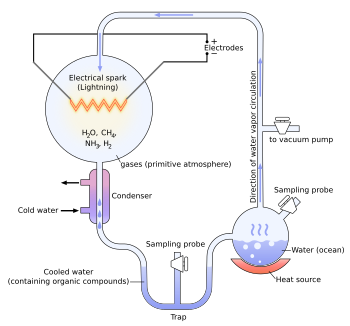
De laget et oppsett med flere sammenkoblede glasskolber. Inni dem fantes det vann med samme sammensetning som urhavet, og en atmosfære som også var ment å ligne den primitive atmosfæren. Så varmet de vannet for  få fordampning og kjølte det ned igjen for at det skulle fortettes (simulert regn). I en av kolbene var det plassert elektroder som det ble sendt elektriske utladninger gjennom.  Etter en stund dannet det seg aminosyrer. Aminosyrer er byggesteiner for proteiner, som er det stoffet live består av. Senere er det blitt foretatt andre, lignende eksperimenter med varierende kjemiske sammensetninger og med UV stråling og radioaktiv stråling som energikilde. De testet egentlig ut en russisk teori om at i en reduserende atmosfære ville det dannes komplekse molekyler når energi ble tilført. Men fra aminosyrer til levende organismer er det ennå en lang vei som ennå ikke er kartlagt.

Det er en rekke teorier som gjelder. Noen tar utgangspunkt i vindpisket skum på en strandkant, andre baserer seg på flåter av pimpstein, proteiner som gror på overflaten på en krystall, proteiner som gror langt nedi jorden eller langs en iskant.

Den første, primitive cellen kunne ikke puste oksygen eller hente næring fra sollys. Den måtte hente energi fra kjemiske substanser. Etterhvert lærte bakteriene seg fotosyntese. Interessant i denne sammenhengen er cyanobakteriene, ofte kalt blågrønnalger til tross for at de er mest i slekt med bakteriene.  Cyanobakteriene er primitive bakterier, svært gamle, helt fra livets spede begynnelse. Som alle bakterier har de ikke cellekjerne, og de har heller ikke kloroblaster slik som plantene har. Istedet foregår fotosyntesen i folder på innsiden av celleveggen. Disse må ha vært i et enormt antall, for de endret jorden. De produserte oksygen som et biprodukt av fotosyntesen og det endret jordens atmosfære og ga grunnlag for utvikling av andre livsformer.

Panspermi-teorien har endel svakheter. For at en metoritt skal inneholde liv, så må den komme fra en planet som har liv. Men en begivenhet som har potensiale å slå løs biter som har energi til å rive seg løs fra planetens (og solsystemets) tyngdekraft, må nødvendigvis være så dramatisk at den i seg selv vil ta livet av de aller fleste organismer. Men det kan selvfølgelig tenkes at i kjernen på et stort stykke finnes noen sporer som overlever. Disse må tåle verdensrommets ekstreme kulde, kanskje ekstrem oppvarming, stråling og selvfølgelig vakuum i tusener, kanskje milliarder av år. Så, når meteoritten endelig treffer en passende planet, så må de tåle oppvarmingen fra nedstigningen i atmosfæren, deretter må de tåle det traumaet som selve nedslaget representerer. Hvis det så likevel skulle hende at disse sporene overlever alt de har gått gjennom, så blir de nå utsatt for ekstreme omgivelser. Hvis de kommer fra en planet der livet har utviklet seg, så kommer de nå til et miljø der vannet er etsende, luften er giftig og inneholder ikke oksygen, det er kanskje ekstrem UV-stråling og det kan være radioaktiv stråling eller partikkelstråling fra stjernen planeten kretser rundt. Kort sagt, den kommer til et miljø den ikke er tilpasset.  Et annet problem, om enn av mer filosofisk karakter, er at denne teorien begrenser dannelsen av liv til en enkelt eller iallfall til et fåtall ganger. Den sier, implisitt, at dannelsen av liv er en tilfeldighet, et engangstilfelle.

Da er det mer tilfredsstillende å tenke at det nærmest er en naturlov at når forholdene ligger til rette for det, så dannes det liv. For det er egentlig ikke prinsipiell forskjell på liv og andre kjemiske prosesser. Forskjellen ligger kun i kompleksitet. For livet er ganske sammensatt, både for de primitive og de mer utviklede organismene. Noen mener at tidsaspektet ved denne teorien er et problem, det at livet ble dannet så forholdsvis raskt etterat jorden selv ble dannet, mens den videre utviklingen har gått saktere.