New webcam

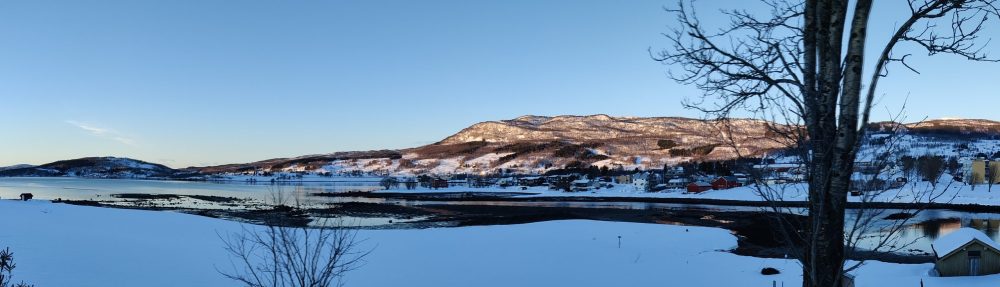
Finally, a new webcam is up and running. This is a so-called 'bullet' camera. It has an outer casing that can withstand weather and wind. The previous one didn't have that; it was a camera intended for indoor use. It was also mounted inside the garage, but I had made a hole in the garage wall so it could look through. This, of course, also limited the field of view somewhat.
This camera is mounted outside, up on the wall, and has a much better view. That is to say, I need to adjust it upwards so that it shows a little more of the sky. I will do that next time I pass by. The camera faces Furøy and Gottesjord. It will be nice in the spring when the sun comes back and shines on the hills of Gottesjord.
Now it is dark for much of the day, and then there is not much to see, except for the lights on the other side. The camera has IR illumination to light up the foreground. The only problem is that there is no foreground. I have still left the IR illumination on because it makes it easy to see if there is precipitation even in the dark. If there are white streaks across the image, then it is raining or snowing. If the streaks are horizontal, then there is also wind.
The camera takes pictures every 10 minutes. It can take up to 5 minutes from when the picture is taken until it is uploaded. The pictures are sent to Weather Underground, where you can see previous images, and you can view a time-lapse video for each day.
Here is the webcam directly
Here is videos and more
The images from my webcam are free for anyone to use for any legitimate purposes. If they are used, I would appreciate it if a small source reference is included.
Have fun!

-But how long was Adam in paradise? The camera stopped working after a few days. Maybe it can't handle frost. Very annoying, but I guess that's what happens when you buy cheap from Wish. To be continued . . .

New name for the site

When I was sitting and looking through the site and what I had written here, it was clearly not just about 'water and such,' which was the old name of the site. So I thought it was appropriate to change it to get a broader scope.
As said, so done, I changed the name. Now the page is called 'about water and life and everything.' It should be a good title that is not limiting.
Men det kommer nok til å bli flere artikler om vann etterhvert. Vann er jo tross alt det som bærer livet essens.

For all creatives

Se etter på høyre side. Der er det en liten tegning. Klikk på linken under, så kan du lage en liten tegning, en droodle, som vises på siden. Jeg håper mange vil benytte seg av denne muligheten. Man kan også legge til en liten tekst. Dette er istedet for en gjestebok. Hvis man ikke vil tegne, bare skrive, så er det også mulig. Bare klikk på «save it», så får du opp muligheten for å skrive.

Det er masse ledig plass på serveren, så tegn i vei

Comments and corrections

I hate printing errors - or typos. Often you look blindly at what you've written and don't realise the errors. Other times, you may not realise that what you've written is incorrect. I emphasise the importance of writing reasonably correct Norwegian, but I can see that mistakes often creep in.

I also try to be accurate with what I write. I often check against Wikipedia and other sources. But not always. And the sources don't always agree on what's correct. So it can be nice to get corrections.

I therefore hope that my readers will be eager to point out any mistakes I have made. Both linguistic errors and pure factual errors.

I also hope to receive other kinds of comments. Be it counter-arguments to what I write, additional information or other things


Aqua Communalis

I have stolen the title from Asterix og Obelix , from the album where Chief Majestetix has a stomachache and has been prescribed a stay at a spa. There is a bathmaster there named Aqua Communalis. By making a somewhat loose interpretation of the expression, you can easily render it as 'municipal water.' For water, and especially municipal water, that is what I am currently occupied with.

Water flows from the tap; it is clean, clear, and can be safely drunk as it is. We take it for granted, but a lot of thought and work goes into making that happen. The ancient Romans were masters with their aqueducts, as they called them. They didn't have pipes that could be pressurized, nor pumps, so they had to build brick channels. If they had to cross a valley, they had to build a bridge to lay the channel on. But they managed it. They supplied cities with large populations with water. Roma In the year 100 AD, there were one and a half million inhabitants, all of whom needed water. It did not flow from the taps in every house and apartment. One had to go to a public baths or public fountains to fetch water. The cleanliness and taste of the water could probably vary, and it is likely that several Roman stomach ailments originated from contaminated water. But they were skilled engineers and tackled the task with the resources they had available.

These are the same tasks we must solve today. We have better resources at our disposal than the ancient Romans. We have pipes of all sizes and materials, we have pumps and filters. We can make the water flow both down and up hills. But we have strict requirements to relate to. The water we provide should be clean and safe for everyone to drink and should flow from the taps with constant pressure.

Nerfossen i Reinelv

Nerfossen i Reinelv

The water is usually fetched from high-altitude rivers or lakes where not many people or animals frequent. As a result, the water is as clean as possible to begin with. Not many years ago, this was considered sufficiently clean to be used as drinking water. People were accustomed to the local bacterial flora present in the water and seldom became ill from it. Only in the larger waterworks in cities was it common to add chlorine to kill bacteria. Nowadays, it is more common to use UV irradiation to disinfect the water. The water is filtered to remove particles in which bacteria can hide. Then, the water is exposed to UV light in a chamber. The light intensity is continuously monitored, and if it becomes too low, the water supply is shut off to prevent bacteria from passing through. In addition, water samples are regularly taken and analyzed for both bacterial presence and harmful substances. Water consumption is monitored to detect leaks in pipelines and distribution networks. You just hold the glass under the tap, fill it with water, and drink. Few people think about everything that has to happen for this to occur.

With modern materials and techniques, we solve the task much more easily and better than the ancient Romans. Nevertheless, it is a big task, especially for small remote municipalities, where the geography often means that several small waterworks must be built instead of one large one. Think about this the next time you pour yourself a glass of water. Imagine the raindrop falling up in the mountains and think about everything it has to go through before it ends up in your glass and can be drunk.

Vann er egentlig et merkverdig og ganske enestående stoff. Det kommer flere artikler om vann etterhvert. Jeg har allerede tenkt på et par allerede, men det kan jo ta litt tid, da……. Stay tuned.

Vanntassen

Blank sheets and crayons

My old pagevann died suddenly and unexpectedly. Actually, it might not have been so surprising, since it has been completely forgotten and ignored and hasn't been updated in a long, long time.

But now I am starting over again, but this time I am trying out WordPress. The old one was built on Joomla. I am by no means dissatisfied with Joomla, but now it is true that change is refreshing, so therefore WordPress.

It will necessarily take some time before any significant content appears here, but it will probably be added gradually. I will try to restore some of the old content if it can be salvaged. It's not entirely certain that it can be done, because as an unwise optimist, I am not good at making backups. But I did, in any case, take a full MySQL dump before I turned off the lights for the old site.