Election

Once again, it is time for the quadrennial ceremony that is meant to legitimize the existence of Parliament politicians. It is election time – a time to hold them accountable for the disasters they have brought upon the Norwegian people and the world at large. Unfortunately, it seems that politicians are increasingly more concerned with power and positions as phenomena, rather than as a means to serve those they represent. This, in turn, contributes to the phenomenon that fewer and fewer people find it worthwhile to cast their vote. It is also not so easy to sift through all the election noise and figure out what one can realistically expect from the various parties. It is mostly about choosing the lesser of the available evils.

Sometimes we just want change. Something different from what has been. It doesn't always go so well. Just look at the USA. They clearly wanted something different. The rest of us hold our breath and hope the world survives. Although we probably don’t have much to be proud of ourselves either. A Bergen sand-sprinkler who is busy spreading sand where her stray dogs have been and peed, or done something worse.

I think this government has been a disaster. Not when it comes to the economy or living conditions. Such things are now mostly independent of the politicians. When things go well, it is usually in spite of – and not because of the politicians. And when things do not go well, those same politicians have very little to contribute. It is always the ordinary people who have to fork out and pay the bill anyway. No, the disaster is that they have made it so that one feels ashamed to have to say that one is Norwegian. They talk about values, but discard all ideals that exist, both Norwegian and international.

We do not have democracy in Norway. There is hardly any country in the world that can boast of having true democracy. The city-states in ancient Greece had it. True democracy can hardly be scaled up to work for an entire country. Instead, we have something called representative democracy.

We choose those who will be our representatives. Let us choose worthy representatives, representatives we can identify with. The very least is that they must have a minimum of common decency.

But most importantly: Make a choice!

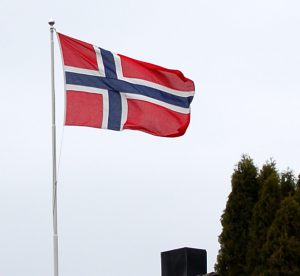
Godt valg


Flags in the 17 May parade

© Hans-Petter Fjeld, some rights reserved.

The other day I saw on Facebook some kind of poll regarding the 17th of May parade. In it, people were encouraged to express whether they think it is acceptable for flags other than the Norwegian one to be carried. It has, after all, become very relevant with an increasing number of people of foreign origin, both those who migrate to Norway and those seeking protection from war and persecution.
Many said NO – there should only be Norwegian flags in the parade. I don't think they have really thought it through. Because May 17th is Norway's national day. The day we celebrate the Constitution and the principles enshrined in it. The Constitution is the sum of Norway's history. The enterprising farmers, the weather-beaten fishermen and hunters, the adventurous Vikings, and all the hardworking people who extracted ore from the mountains. Norwegians have always loved freedom, but have also seen the necessity of having laws and rules to follow. "At lögum skal land várt byggja en eigi at ulögum øyða," said the old Frostating law, meaning, 'With law shall the land be built, and not with lawlessness destroyed.' Already in the 11th century, laws were important. And there is one thing worth noting: The old Norwegians did not go to King Solomon to have him judge their disputes; they took their cases to the assemblies (tings) and had them resolved there.
Our Constitution is not perfect. But it is the best we have, and I believe it is among the best in the world, so it is well worth celebrating. And celebrate we shall – but we must not "be self-sufficient." Norway is not a distant planet floating in an impenetrable void. Norway is, for better or worse, in the world.
Marching in the May 17th parade is how we show our Norwegian identity. We do not have military parades displaying weapons. We march in processions, sing, shout hurrah, and wave flags. And there are many different flags in the May 17th parade. Each school, each kindergarten, each band, each stand, each guild has its own banner under which they march. Everyone shows their identity, united under the Norwegian flag. There is, after all, no fundamental difference between a banner and a flag. Both are symbols of belonging. Of course, the Norwegian flag holds a special position, especially on May 17th. Those who are in Norway for various reasons, whether as guests, for work, or seeking protection, and who wish to participate in the celebration, should we demand that they erase their identity? Sail under a false flag, so to speak.
A ship sailing in the waters of another country flies its own country's flag and the flag of the country it is visiting. Flying its own flag is a symbol that shows identity, indicating where it comes from. The flag of the country it is visiting symbolizes that it is on a peaceful and legal voyage and has no ill intentions. In the same way, we can also look at different flags on National Day.
A flag from another country will not diminish the Norwegian one. On the contrary, it shows that Norway is a good and safe country where it is good to live. We should be happy that others want to celebrate with us, and that they want to show who they are.

Of course, it is now up to each individual which flag they want to carry, but as I said, I would find it natural to carry both flags for those who wish to do so.

The Christmas gift of Mars

Will the world last until Easter? Maybe, maybe not – stranger things have happened before. And besides, it’s not that long until Easter anyway. Besides, time is an oval thing, I’ve heard. The axes aren’t equal. Maybe that’s why the seasons jump around a bit. Just when summer is about to begin, there’s the worst snowstorm in a long time. Also, it’s usually considered commendable to be early. But the thing is, today I actually received the first Christmas present of the year! Yes, indeed. A Christmas present. And she was quite cheerful, the one who brought it and declared it to be an early Christmas gift.

It so happens that I easily develop a very close and personal relationship with my footwear. And good friends who have stuck with you through thick and thin, wet and dry, are not easily parted with. At least, one must try to gradually get used to the loss. A couple of times it has happened that I have been at the dumpster and rescued old, faithful friends – amid strong criticism and threats in harsh words, of house bans and worse.

But sometimes it's just over. When sudden sinkholes and persistent cracks appear in the millimeter-thin layer that is supposed to protect the soles of the feet from everything that could possibly trouble an unprotected foot, it's time to resign and let the garbage truck take what belongs to the garbage truck. Because I am a strong advocate of the universal use of moccasins – both fish entrails and party they must endure. And they do, but not forever.

Now, it's not as if I am currently wearing worn-out shoes. No, they still have good durability left. The problem is slippers. I have a pair of indoor slippers. The kind you can shuffle around the living room floor in. And they are probably not exactly new. Do you remember the old Kandahar ski bindings? The ones that had a little clip over the toe, and then a spring that tightened around the heel and held the boot in place in the bindings. If you ignore the spring, imagine the clip replaced by some thin woolen material, and then imagine something loose from the ski dangling around, partly under and partly behind the foot, that’s roughly how the old slippers look. But actually, there's nothing wrong with them. They’re not that old either, and they’re warm and comfortable. But then there are people who have set their eyes on them and decided that it’s advisable to replace perfectly functional foot warmers. Well, I’ll probably get over it eventually. Maybe. But then you also need to have a strategy ready for when the nights get long and the cold sets in. For Christmas presents in March – that is completely unacceptable, rude, and utterly reprehensible. Namely.

Now it's just a matter of finding a discreet – very discreet – place for the old slippers to hidewhen I take them off. They are just too good to go through every slipper's final journey to the eternal carpet floors. And then there's the fitting and adaption. It's particularly important to get the heel cup properly adapted for quick on and off.

World Water Day

World Water Day is on March 22. This year, the focus is on used water and what we can get out of it. Because we preferably like our water cold, clear, and clean. Once we have used the water, it no longer meets these requirements. Then we usually want to get rid of it as quickly as possible. But in fact, it is this used water that is the valuable water. We do not want to drink it or wash in it, that's true. It is not very appealing to look at, that's true. But it contains a lot of nutrients that we just flush away. So many nutrients, in fact, that it creates problems where it ends up. The ocean is unique when it comes to receiving nutrients. Because there is enormous production in the sea, and it needs lots of nutrients. We are used to the ocean absorbing everything it gets. But even here, it can be too much. Some of us may remember the algal blooms at the end of the 1980s. It was the dinoflagellate Chrysochromulina polylepis, which first bloomed along the west coast of Sweden and then followed the currents along the coast of Norway. It killed or damaged almost everything in its path, including fish, shellfish, and algae (seaweed and kelp). The bloom was due to overly nutrient-rich water, favorable temperatures, and other conditions being conducive to a massive bloom. There have also been several such blooms of different types of algae, but none with such extensive damage. In Northern Norway, we are more sparsely distributed, and there are fewer of us, so we are not as exposed. But even here, it is important to limit the discharge of nutrients.
Freshwater does not have as high production as seawater. Neither are mechanisms like tides, changing currents, and wave dynamics present, at least not to the same extent as in seawater. Therefore, freshwater is much more sensitive to nutrients than seawater. Especially phosphates lead to eutrophication in freshwater. In the area around Mjøsa, almost only phosphate-free detergents are used, which, together with other measures, have had dramatic effects on the water quality in the lake.
It is important to take care of water quality, both in rivers, lakes, and especially in the sea. If there are too many nutrients, eutrophication occurs, leading to overgrowth in the water, which becomes brown and murky, and dead plants and animals sink to the bottom. In the bottom sediments, bacteria break down the dead material. These bacteria consume the oxygen in the water. In the bottom sediments themselves, anaerobic decomposition processes take place. The result of these processes includes hydrogen sulfide, a toxic gas that smells like rotten eggs. The water becomes toxic and oxygen-deprived.
The same can happen in the sea as well. In fact, it is normal in threshold fjords where there is no exchange of bottom water beyond the threshold. Organic material sinks down and forms bottom sludge. This decomposes without oxygen and makes the water toxic. Occasionally, such water can be stirred up and come up from the depths, causing fish deaths. The discharge of nutrients from sewage and runoff from agriculture can pollute large sea areas and disrupt the natural growth cycles in the ocean. This can lead to algal blooms and oxygen depletion.
There are several ways to treat wastewater. The simplest is to let it flow into a tank so that the solid substances settle and form a layer at the bottom. The water then continues and infiltrates into the ground. This is how a septic tank works. That system works in sparsely populated areas. In more densely populated areas, a communal treatment plant is made. This means collecting the wastewater from several houses and treating it in a shared facility. Then it is also possible to further increase the level of sedimentation by adding a substance that causes the smallest particles to clump together so that they settle more easily. This can be combined with mechanical filtration. Sand filters are effective, but they take up a lot of space and require much work to clean. One method that produces almost completely clean water is to let the water trickle over bio-bodies, plastic units with a large surface area, while air is blown through the system. This creates a bacterial layer, a biofilm, on the surface of these units. This bacterial layer consumes the nutrients. Any pathogens are also consumed and deactivated. The bacterial layer on the bio-balls grows and must be removed periodically. Then, the bio-balls become ineffective until they develop a new bacterial layer. Therefore, this is usually done as a continuous process where a certain number of bio-balls are cleaned at any given time while the remaining ones continue to perform their function. The material removed from the bio-balls is a good fertilizer and soil improvement product. The same applies to sludge from sand filters and septic sludge, though following a maturation process in which bacteria and yeast break down nutrients and harmful bacteria.
Water is important! It is our most important nutrient. We cannot live without water. No animal can. Even camels and dromedaries, which can convert the fat stored in their humps into water, have to drink. And they drink a lot when they do. Some animals get all the water they need from the food they eat, but if they don’t get the water, they die. The sea is important. A large part of our food comes from the sea. As the world’s population demands more food, it is probably only the sea that has the capacity to provide this food. Moreover, a large part of the oxygen that life on Earth needs is produced in the sea.
Tank på havet. Tenk på vann.

Kråkeslottsfestivalen (Ramshacle castle festival) 2016

One thing I am sure of – I am not going to be troubled by kidney stones in the near future. It should also be noted that it is an affliction I have never suffered from. But in any case, I have just been fully vaccinated against such conditions. You see, I try to make it to the Kråkeslott Festival every year. So I did this year as well. I find it a bit too much to attend for three full days straight, so this year I chose Saturday. I am also the kind of person who is somewhat slow when it comes to preparations and planning, so it ended up being a bit of a last-minute ticket purchase. As a result, there is also a light aura of chance over the selected events. That is, Toini and the Tomcats was no coincidence. They were rather the reason I set off on the trip. But I had two more tickets – once you're going on a trip, you have to get the full value. And I knew very little about those performers. So, after running various errands in Finnsnes, I headed out toward Senja and just about made it to the first concert. I sneaked in half-dark wearing glasses that were still dark from the daylight outside. It was just a matter of feeling my way and finding a chair to sit on where no one was seated yet. If I'm going to sit on someone's lap, I want to know whose it is! Among other simple reasons, it must be a lap that can handle the weight. That means it has to be reasonably solid. However, I found an empty seat so that, without touching anyone, I could focus on the beautiful sounds coming from the stage. There stood a young girl and a similarly young man, the latter with a guitar, the former just herself. And, folks, here we have a future new star on the jazz horizon. It was indeed Tiril Lill Jackson who stood there and sang. With a voice that has the potential to belong among the greats, it was definitely the one thing that alone was worth the trip.
But all too soon she was done with her repertoire and disappears to the left (actually to the right, but now in drama, you disappear to the left...). In come a group of young boys. One is wearing a hat, and he sits down at the drums. Then there is one with a bass guitar and two more. One takes the microphone and tells us what we are going to hear. But it seems as if the drummer was raised on impatience along with mother's milk, because he immediately starts pounding on whatever can be pounded and produces sound. And here we are not talking about gentle touches on the drum skin through a towel on the snare drum to make it less sharp. Oh no, here it is full throttle and full edge from the very first moment. And that goes for bass, guitars, and vocals as well. Speaking of vocals, it was a bit like opera. If you haven't read the libretto beforehand, it's challenging to follow the lyrics. I therefore quickly fell off the wagon regarding the message. But as Kim Larsen once said when he was asked what message he was trying to convey with his music: 'Message – that's something for the postal and telecom services.' Just as with opera, the music itself has its own value, independent of the vocals. I therefore sat and listened. Well, 'listened' may not be entirely accurate, because it certainly wasn't necessary to hold my hand behind my ear to hear better. The volume was sufficient, more than sufficient, and the music was performed with both engagement and virtuosity, and with enough power to crush both kidneys and gallstones. As for the drummer, whom one could not help but watch, the hat soon left the top, but the hi(h)hat remained. All in all, a rhythmic, engaging, and very loud session. It will probably never become my favorite genre, but very nice to listen to every now and then, especially when served live by such an inspired group as 10th harmonic.
The next concert I had tickets for was with Faun Fables all the way from California. Now, I actually thought that the fauns preferred to thrive in Mediterranean climates and were otherwise almost extinct. Apparently, that's not the case, and there was considerable emigration from Italy to America, so one or two fauns could very well have come along. California is also both warm and sunny, so it could be a good place for fauns. The music was also a bit special; I heard a mix of elements from Latin, American, and Nordic traditions – and something somewhat indefinably atavistic. And then they had a very charming ending with two little trolls who came in and contributed strong, but not entirely in-tune voices. But the potential is there, so…
Finally, it was the cherry on the cake. Toini and the TomcatsGlittering professionalism and musicality. I was seated in the orchestra section, second row from the front, with a full view, both acoustically and visually. One could say that the acoustics were perhaps a bit excessive, but still, that's just a minor detail. It was a wonderful experience, in addition to hearing the music, also to see how the bassist hammered away on the poor bass. It almost made you feel some sympathy for the poor, innocent instrument. Not that the drummer was any gentler. He kept hitting away. They made fantastic music. When it was over, I felt a slight envy towards those who had tickets to the party afterward. But I didn't, so it was just a matter of heading home. And to be sure, I did not regret any of what I had experienced, but I regretted a little some of what I did not get to experience.

So - until next year...
Should there be anyone who feels called to enrich this little story with illustrations, it will of course be received with thanks – but just thanks, nothing else. Send illustration

PS.
In my ecstatic excitement over the music, I completely forget the very core of it all. The ones who keep the engine running and make the whole thing possible. Namely, those who work tirelessly and organize it all. I don't know, but I assume there are tons of volunteer efforts behind it. And that there are some passionate individuals behind it. I don't know who they are; they obviously don't care much for highlighting themselves. They deserve a big thank you, honor, and acclaim!

Ascension Day meditation

Then it's a day off on a Thursday. A public holiday, even. What can you do on a public holiday, those of us who don't hold anything particularly sacred? Launch a boat, for example. It's a nice thing to do on a May Day holiday. With good help, this is done quite quickly. There will also be a little test drive with the kids down the eddy (a slough down the stream here). I was admittedly just a spectator on the shore, but I could clearly hear the cheers as they went back through their own waves.
Dinner. A mostly self-cooking steak. You put it in, after a while you take it out and voilà. Quickly made and quickly eaten.
The weather is not exactly brilliant, but it is okay. Actually, much more than okay, because it is dry, quite quiet, and despite being cloudy, it is a comfortable temperature. Admittedly a little too chilly to sit outside in just your shirt sleeves, but with a thin sweater on it is just right.
So the coffee is enjoyed outdoors. Then you can sit and watch the seagulls bubbling over with spring excitement and who love to proclaim their happiness quite loudly. The tent too, but it's freezing on its feet, poor thing. That's why it keeps shouting: "it bites, it bites". The seagull is so busy renovating and preparing the children's room that it doesn't even have time for its favorite activity: teasing the cat. The cat monster, for its part, has probably been brutally deprived of the spring excitement-inducing body parts, but it can still enjoy snow-free and cat-friendly outdoor temperatures. Just being able to do its toilet in soft, frost-free spring soil is a great cat welfare. Otherwise, it suffers from advanced agoraphobia after successfully killing a seagull cub a few years ago, something it has never been forgiven for. It mostly sneaks from cover to cover while constantly being on the alert for sneak attacks from the air. Only when it has company outside does it feel safe and can roll in the gravel and strut around proudly, with its neck erect and its tail carried high.
It's nice to sit outside like this and enjoy a cup of coffee while observing life around you. Then you can let your thoughts flow as they please, without any kind of control. I guess that's what some people call meditating. Sitting like this and thinking without thinking, that's what I was really going to tell you about, not about cats and seagulls and other screamers. But now the coffee has gone cold, it's actually a little chilly here, and the inspired nothingness has mostly disappeared into nothingness.

Until next time

How clean is the water?

I verden er rent drikkevann en mangelvare og en luksus. Norge er på mange måter ett unntak. På grunn av vår beliggenhet ved randen av Atlanterhavet og med en et hovedsakelig sørvestlig værretning, så blåses det store mengder atlantisk fuktighet inn mot kysten. Vinden må stige over fjellene, først ved kysten og senere over de høye fjellene lenger inne i landet. Da avkjøles luften og slipper fra seg fuktigheten som snø og regn. Derfor har vi mengder av vann som vi bruker til kraftproduksjon og andre ting. Litt bruker vi også til drikkevann. Vi har så mye vann at vi kan frede noen vassdrag og la vannet renne fritt til glede og adspredelse for mange.

Foss

Foss

I Norge er vi vant til å hente klart, rent og friskt vann rett fra naturen. I spredt bebyggelse er det mange som ennå får vannet sitt fra brønner uten noen form for behandling eller rensing. Noen har bygd brønnen sin over en kilde eller et oppkomme. De kan ofte ha et veldig godt og mikrobiologisk rent vann. Andre får tilsig til brønnen sin fra bekker eller fra jordsmonnet. Dette vannet kan nok være mer tvilsomt med hensyn på mikrobiologi, lukt og smak. Men uansett, så er de aller fleste fornøyd med vannet sitt og mener at de har et godt drikkevann.

Vi tåler noen bakterier i vannet. Immunsystemet vårt lærer seg å takle den bakteriefloraen som fins. Noen mener tilogmed at det er sunt at immunsystemet har noe å gjøre, og at vi lever i et alt for sterilt miljø. Det kan nok hende, men vann er det aller viktigste næringsmidlet vi har, det vi inntar hver dag og som inngår i nesten alle matretter vi kan finne på å lage. Selv om en er vant til bakteriefloraen, så kan det være spesielle forhold som gjør at en får oppblomstring. Så kan det jo også komme innom noen som vi ikke er tilvent. Unger, og spesielt spedbarn som ikke har fått utviklet og tilpasset immunsystemer er utsatt, de tåler også uttørring dårligere, og mageinfeksjoner være alvorlige bade for unge og gamle.

Det beste er nok å ha vannet så rent som det er mulig. I drikkevannsforskriftens kapittel 6 er det beskrevet hva som tolereres, både av mikrobiologisk og kjemisk forurensning. Kimtall forteller hvor mange levende organismer, bakterier og sopp som kan påvises pr milliliter vann. Kimtall er et godt mål på hvor rent vannet er. Vann med kimtall over 100 kan være greit å drikke, men da må vi undersøke hva som er årsaken til forurensningen. Koliforme bakterier tolereres ikke i det hele tatt, og hvis det finnes E.coli bør vannet kokes før det kan drikkes.

Viktig å ta hensyn til

Merking av nedslagsfelt

Vi tar rutinemessig prøver av vannet hver 14.dag. Det tas prøver av råvannet, det som kommer inn til vannverket, renvannet som går ut og det tas prøver ute på fordelingsnettet. Fra hovedvannkilden vår får vi rimelig rent vann. Inntaket ligger dypt, under sprangsjiktet i vannet. Kimtallet ligger normalt på 20 til 50cfu og det er godt drikkevann. Likevel går det gjennom et mekanisk filter som tar eventuelle partikler som følger med. Deretter blir det desinfisert med kraftig ultrafiolett lys som dreper det meste. Renvannet som kommer ut har kimtall mindre enn 5cfu. Som oftest er det null (cfu er forøvrig en betegnelse som laboratoriet benytter for kimtall. Det står for colony forming unit – kolonidannende enhet). Underveis plukker vannet opp en og annen organisme, og når vi tar prøver hos en abonnent, så er det ikke uvanlig å få et kimtall på 3-7cfu. En sjelden gang kan det være høyere, men aldri i nærheteten av tiltaksgrensen på 100.

Ved vannverkene på Hemmingsjord og på Reinelv må vi behandle vannet litt mer før det kan drikkes. De vannkildene gir ikke så rent vann at det kan brukes direkte. Vannet har dessuten mer farve enn det drikkevannsforskriften tillater. Farve og forurensninger kan dessuten føre til at UV-desifeksjonen ikke fungerer optimalt. Vi må derfor fjerne farve og forurensninger. Det gjør vi ved å tilsette et stoff (polyaluminiumklorid, PAX) som får forurensningene til å klumpe seg sammen slik at de lettere kan filtreres ut. PAX’en tilsettes i en statisk blander, et stykke rør med innvendige skovler som sørger for god blanding. Etter innblandingen går vannet direkte til sandfiltre. Teknikken kalles direktefiltrering fordi det ikke er noen oppholdstid der forurensningene får bunnfalle.

Sandfilter

Terje sjekker sandvaskestasjonen i toppen av filteret


Sandfiltrene våre er veldig avanserte og effektive. De er av typen «moving bed» filter. Det vil si at sanden beveger seg. Den beveger seg motsatt vei av vannstrømmen og blir kontinuerlig vasket i en vaskestasjon på toppen av filteret. Etter å ha gått gjennom filtrene er vannet rent og kan godt drikkes. Men forskriften forlanger at vi skal ha to hygieniske barrierer. Vannet blir derfor i tilleggg desinfisert med kraftig ultraviolett lys.

Vannverkene våre er utstyrt med

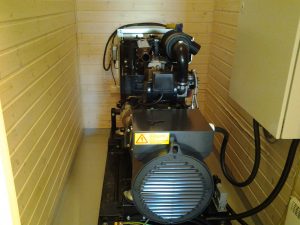
Dieselgenerator

Reservekraft til vannverket

reservestrømforsyning for å kunne opprettholde produksjonen og de viktigste funksjonene i tilfelle strømbrudd. I tillegg har vi lagret vann for omtrent et døgns forbruk i høydebassenget. Det får dessverre ikke Hemmingsjord og Reinelv nyte godt av. På Reinelv er det et lite lager, men på Hemmingsjord blir det dessverre tomt i løpet av kort tid. Det får vi rettet opp om vi etterhvert får forbundet Hemmingsjord med hovedvannverket.


Høyebassenget har en vannflate på omtrent 80 m over havflaten. Det tilsier at maksimalt statisk trykk på den laveste ledningen er litt under 7,5 bar. I tillegg kommer strømningstap som varierer med forbruket, men det kan ofte ligge på en halv til en bar. Vannet kommer fra

Ventilkum

Slik kan det se ut nedi en kum

hovedvannverket og fylles rett inn i bassenget der vannstanden reguleres med en automatisk ventil. Fra høydebassenget fordeles vannet til abonnentene. I underjordiske kummer finnes fordelinger, slusekraner for å stenge av vannstrømmen, lufteklokker for å slippe ut luft fra ledningen, trykkreduksjonsventiler, utspylingsmuliheter og brannventiler. Noen kummer er små og kummerlige, andre er store og har både lys og varme.

Men det er ikke overalt man klarer å få vannet til å renne av seg selv. Noen liker å bo høyt og ha fin utsikt. For at alle disse skal ha vann, så har vi trykkøkningsstasjoner. I Sørreisa har vi åtte rene trykkøkningsstasjoner og en som kan både trykkøkning og trykkreduksjon, alt etter hvilken vei vi vil at vannet skal strømme.

Det er mye arbeid å holde vannforsyningen i orden. Det er mange faste rutiner som skal følges.

Inntaksdam

Rengjøring av dam

Noen av disse er ofte, andre er sjeldnere.  Vannprøvetaking og kalibrering av måleinstrumenter er noen av de faste rutinene som gjøres ofte. Sjeldnere er inspeksjon og rengjøring av vannkildene. Så må filtre og uv – anlegg renses og vedlikeholdes. Det må skiftes uv lamper og rengjøres. På bildet til venstre holder vi på å rense opp inntaksdammen. Det følger masse sand med elven som fyller opp dammen. Da må vi tømme dammen og grave ut sanden med jamne mellomrom. Samtidig får vi renset ut lauv og grener som har fulgt med elven.

Rørledningene må også renses. Det gjør vi ved å sende renseplugger gjennom rørene. Da løsner all skitten som har festet seg på rørveggene og vannet blir skikkelig brunt. Det

Lekkasje

Lekkasje

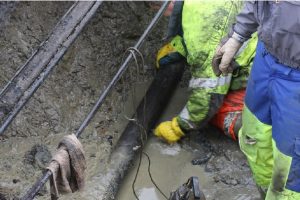
må skylles ut til det bare kommer blankt og rent vann.  Når sluseventilene som står nedi kummene blir gamle og slitte og ikke tetter ordentlig, så må de skiftes. Lekkasjer oppstår fra tid til annen. Da må først lekkasjen lokaliseres, så må røret graves fram og repareres. Noen ganger kan det være vanskelig nok. Særlig hvis det er som på bildet til høyre. Der er det flere kabler som går i samme trasé som røret. Å grave over slike kabler legge død både telefon og dataforbindelser og det kan lett bli både dyrt og upopulært, så her er det om å gjøre å være forsiktig.

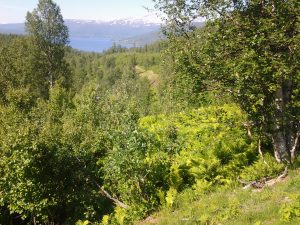
Til slutt vil jeg ta med et bilde som er tatt under et av de triveligere gjøremålene som tilhører en vasstass, nemlig inspeksjon av vannkildene.

SAMSUNG

Reinelv

Vegavann

Vegavann

Where does the used water go?

We get clean, fresh water into our homes. First-class drinking water. The water we release is not quite as clean. We have used it to wash ourselves, to wash cups, clothes, walls, and floors. We have urinated in it and done other things in it. In short, the water we send away from us is not very clean. We usually don’t think much about it. We just pull the lever when washing, or pull the cord – well, nowadays toilets have a button, not a cord – okay, we press the button and whoosh – it’s gone. Before the time of water closets, there was the era of outhouses. Outhouses and dung heaps are fine as long as they’re not too close together. In towns where people lived close together, and all waste had to flow along the streets or in the gutters, it could be quite unpleasant to walk. By the way, the word 'dass' is of German origin. It is a euphemism for a euphemism, namely for 'das Raum' – the room, for an even worse designation for premises for bodily functions.

The ancient Romans were a clean people. They had a decent system. There were public toilets where one sat on a stone bench with holes in it, and the waste would fall into a channel and be carried away by a stream of water. There was also a number of sponges available, conveniently mounted on a stick, which one could use to clean oneself in the rear areas. Then you would just rinse it in the water stream and prepare it for the next “guest.” Practical and hygienic.

The upper class in Europe, at least the top part of the upper class, had toilet chairs – chairs with a built-in chamber pot to catch the noble excrement. The most advanced chamber pots even had built-in butt wipers. It was actually considered a prestigious job to be a royal butt wiper. Among the common people, the conditions were probably more Spartan. But regardless of the type of toilet used, the waste ended up in the street. And it was hardly pleasant to step in, no matter how royal it might be. Some of the waste perhaps went into a river or a canal and was carried away, but that same river was also drinking water for others. Runoff could also seep into wells and other water sources. Eventually, it became quite intolerable. People started to build sewers and water pipes. In London, in the 1850s, 2,100 kilometers of water and sewer pipes were constructed. This led to a dramatic decrease in mortality. Cholera and other diseases almost disappeared.

The importance of a well-functioning sewage system is obvious. Many, especially in sparsely populated areas, have septic tanks. It is a small treatment plant in miniature. It is a tank with several chambers where solid materials are allowed to settle, and there is also a composting process of the waste. So the solids settle at the bottom, and the water is directed into an infiltration pipe, where it is purified by seeping into the soil. The tank must be emptied at regular intervals, and the settled solids are transported to a landfill. In denser settlements, there is usually a public sewer system. The sewage is transported away through pipelines. If the terrain slopes, it is quite simple. Then you just lay a pipe, and the water flows downward on its own. But often there are obstacles, uphill sections. Then you may need pumps to get the sewage where you want it. Here in Sørreisa, we have a total of 11 stations that pump sewage. Each station has a sump with two pumps. They alternate in operation, one at a time. If the level rises in the swamp, when a single pump can no longer keep it at bay, both start.


But where should we then put the waste? It is infectious and unappetizing, and it smells bad. Should we release it into the sea? A fjord into which wastewater is discharged is called a recipient—a receiver. One can then calculate how much discharge a recipient can tolerate before it starts to become polluted. This depends on several factors. Weather, waves, and currents are very important. We no longer release untreated sewage into the recipients. Nevertheless, some dry matter remains, depending on the degree of treatment. Calculations are made of the amount of dry matter, and a discharge permit is issued. Measurements and analyses are usually conducted to document that the calculations are correct and that the treatment works as it should.

Wastewater treatment can be done in several ways and to varying degrees, depending on how sensitive the receiving environment is. One method is to release the wastewater into a tank and allow the solids to settle to the bottom. Then, relatively clean water can be skimmed from the surface and released. Alternatively, chemicals can be added so that small particles suspended in the water stick together and become large enough to sink. The water that comes out will then be quite clear. But further treatment is possible. For example, water can be trickled over bio-bodies. These are plastic structures designed to have a large surface area that also has good access to air. The surface of these structures will eventually be covered by a biofilm, a layer of microorganisms that consume the pollutants in the water. Periodically, some of these structures are removed and cleaned of biofilm. They then re-enter the process and build a new layer…

This is how one can continue to purify water until it can be used as drinking water again. But we rarely do this in Norway. We usually have new water to use for that. However, the collected substances, including washed-off biofilm, sludge from septic tanks, sediment from municipal sludge separators, and sludge from treatment plants, are transported away and either deposited or further processed until they can be used as fertilizer or soil conditioner.

For both private and public sewage systems, it is important to ensure that drainage water does not enter the sewer. This creates challenges for capacity, both in the pipelines and any pumps, and it can cause sewage to flow back into houses during flood conditions.

In Sørreisa, many people have private sewage systems with septic tanks. Additionally, we have some public sewage systems with sludge separators. Then we have two treatment plants, one where the wastewater is allowed to settle in a tank, and then the sludge is flushed into a storage tank. The water is decanted, skimmed off, and released into the sea. In the other, chemicals are added to increase sedimentation, but here the decanted water is released into freshwater. Therefore, a higher level of treatment is required.

Maintenance of sewage systems is demanding. The system has been developed over a long period, and different materials have been used. Sometimes, ground settling causes the pipes to separate, leak, or get crushed and blocked. Where there are concrete pipes or other pipes with joints without seals, it is a favored spot for various plants to send in their roots to absorb high-quality nutrients. Paper and other debris then tend to get caught in these roots, and the pipes can become blocked. Such pipes must be replaced or cleaned. Sometimes we need to insert a camera into the pipe to find out what is wrong. Pump stations and pumps must be maintained and overhauled at regular intervals.

Overall, there are many things to be mindful of and many processes at work. Think about this a little every time you flush the toilet. And remember: do not empty the mop bucket into the toilet. Clumps and mops are the worst things that can get into our pumps. This leads to having to lift the pump, disassemble and clean it, and then lower it again. Sometimes such things can damage the pump's seal and result in costly repairs. Wet wipes are also something we dislike. They are made of fibers that do not dissolve in water, can get caught, cause clogged pipes, and may damage the pumps by getting between the impeller and the seal.
Why do we have weather

Hvorfor har vi vær?
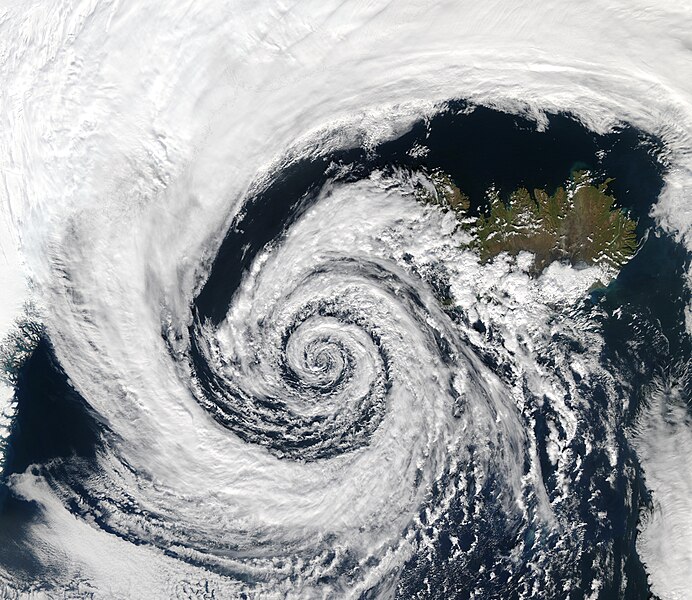
Ville vi hatt det bedre uten vær? Noen ganger kan man vel ønske seg inderlig at det skulle være litt mindre vær. Motoren som driver været er i hovedsak solen, men også tidevannskrefter fra jordens rotasjon og fra månen er med på å tilføre energi til været. Jo varmere jorden blir, jo kraftigere blir været. Selve kjernen, stempelet i motoren som driver været er vann som samler energi ved jordoverfalaten (eller havflaten). Det fordamper og stiger opp sammen med soloppvarmet luft. Etterhvert som det stiger opp, synker temperaturen og dampen kondenseres til regn. Under denne

Lavtrykk over Island (wikipedia)

prosessen avgir den varme til omgivelsene, luften og den oppadstigende luftstrømmen forsterkes. Når luften stiger opp slik blir det mindre luft ved overflaten. Det har oppstått et lavtrykk og luft begynner å strømme til fra alle kanter for å fylle opp «tomrommet». Det har oppstått et lavtrykk.
Luften prøver å strømme rett mot lavtrykket, men det får den ikke til. På grunn av jordrotasjonen vil den bøyes av til høyre nord for ekvator og til venstre sør for ekvator. Dette kalles Coriolis effekt. Vinden strømmer inn mot lavtrykket i en spiral, mot klokka nord for ekvator, med klokka på den sørlige halvkule.


På grunn av den oppadstigende luften og fuktigheten som kondensere i høyden følger det alltid skyer og nedbør med lavtrykk.

Det motsatte er tilfelle med høytrykk. Høytrykk dannes der overflatetemperaturen er lav. Kald luft siger ned og blir oppvarmet. Det fører til at luften blir tørrere og skyene forsvinner. Luften forsøker å strømme rett ut fra høytrykket, men også her gjør Coriolis effekt at den strømmer i spiralform, men den sirkulerer i motsatt retning av lavtrykkene. Høytrykkene forbinder vi med godt og klart vær.

Noen høytrykk er permanente, andre er tilbakevendende. For eksempel er det et permanent høytrykk over sydpolen. Det gjør at sydpolen er jordens tørreste område. Det kan også forårsake drepende kalde, sterke vinder fra polplatået. Andre tilbakevendende høytrykk er et kraftig høytrykk over Sibir. Dette dannes på vinteren og kan vare i månedsvis. Det fører til ekstremt lave temperaturer og påvirker været på hele nordkalotten. Et annet er et høytrykk over Azorene som påvirker været i Europa, Nordafrika og hele Nordatlanteren. Noen ganger kan det strekke seg helt over til Amerika og da kan det styre tropiske orkaner inn mot kysten.

Vær er mye mer enn lavtrykk og høytrykk. Det er passatvinder, monsunvinder, jetstrømmer,havstrømmer, bølger, hadleyceller og mye mer. Men alt i alt, det været gjør er å transportere energi fra der det er hett til steder der det er kaldere.

Hvis vi ikke hadde denne effekten ville temperaturen ved ekvator bli drepende høy, og tilsvarende ville temperaturene på nord- og sørkalotten bli ulevelig lave. På grunn av været blir solenergien fordelt over hele kloden og den biologiske produksjonen kan foregå overalt.

Selv om det kan synes slik av og til, så bor vi ikke her til tross for været, vi bor her på grunn av været.

Les mer om været på <a href="/en/»http://met.no»/">met.no</a> eller på <a href="/en/»http://yr.no»/">yr.no.</a> <a href="/en/»https://no.wikipedia.org»/">Wikipedia</a> har også mye stoff om vær


Selfie

Her om dagen var jeg innom bokhandelen. Ja, for jeg er litt gammeldags av meg. Jeg liker best å lese bøker fra papir. Så innimellom tar jeg meg en tur i bokhandelen for å kikke ha de har i hyllene. Av og til har de mange bøker, men andre ganger har de omtrent ingenting. Joda, de har vel noen bøker stående rundtomkring, men ingen som jeg finner leseverdige.
Denne gangen var det særdeles magert. Jeg gikk og kikket rundtomkring i hyllene, men det var ingenting å finne der utenom kokebøker, bloddryppende kjedelig krim og selvbiografier, enten fra selvhøytidelige alleermotmegpolitikere, narcissister med ulevde liv eller ukunstneriske kunstnerlidelseshistorier. Kort sagt, ingenting å lese.
Men det var en bok jeg ville spørre etter – jeg husker ikke hvilken – så jeg gikk til disken. Ekspeditøren, en ung jente, var opptatt med å ekspedere en annen kunde. Mens jeg ventet, stod jeg og så meg omkring. På disken, ved siden av kassaapparatet lå det noe underlig. En slik teleskopstang – som en radioantenne som kan trekkes ut. Eller en sånn stang med magnet eller gripeklo som en kan bruke til å fiske opp skruer eller annet som en har mistet nedi motorer eller lignende. Det var bare gripemekanismen i enden jeg ikke kunne forstå meg på. Den lignet ingenting jeg hadde sett før. Jeg stod og studerte denne tingsten fra alle bauger og kanter. Men da ekspeditøren var ferdig var også nysgjerrigheten uimotståelig, og jeg måtte spørre. Selfiestang svarte jenta med et lite flir. Kanskje hun trodde jeg skulle kjøpe en. Hun hadde heller ikke den boken jeg ville spørre etter, så det ble heller dårlig med handel.
Men jeg har jo lagt merke til at det er blitt veldig populært med selfier på facebook. Alle facebookere med respekt for seg bør vel ha en selfie. Så jeg har lenge tenkt på å ta et selfiebilde. Problemet er at slike selfier viser helst vakre, slanke, nystriglede og blankpolerte unge jenter. Nå er det slik at undertegnede ikke fyller noen av disse kravene.selfie
Da kom jeg jo på en glimrende ide. Jeg kjører jo rundt i en nypimpet aquabuss. Den kunne jo ta hovedrollen, så kunne jeg inneha rollen som statist.
Som sagt så gjort. Ved hjelp av en uteleskopisk, fjernstyrt selfiestang ved navn Tormod ble bildet tatt. Og her, mine venner, er bildet. Man føler seg en smule toskete når en poserer for en selfie. Men det får så være. Nå kan vel ingen påstå at jeg ikke er en ordentlig facebooknerd.

Når et gjelder skiltet jeg har på taket, så må jeg poengtere på det sterkeste:

ALLE S’ene skal være med